If you’ve recently been told that you need braces, chances are this is the first question that came to your mind:
“How long do braces take to straighten teeth?”
And honestly, it’s a fair question.
Whether you’re a teenager preparing for college, a working professional, or a parent considering braces for your child, you want to know one thing before committing to treatment. How long will I have to wear them?
Many people hope for a simple answer like “12 months” or “18 months.” But orthodontic treatment doesn’t work like ordering a package with a fixed delivery date. In general, most orthodontic treatment takes between 12 and 24 months. But it differs for each individual. There isn’t a fixed timeline (more about it later).
Some patients notice visible improvement within a few months. Others may need close to two years or more. The difference isn’t because one person’s braces work better than another’s. It’s because every smile has a different starting point and a different destination.
The good news is this. Most people begin seeing positive changes much earlier than they expect.
Let’s understand what you can realistically expect from orthodontic braces treatment, what affects the timeline, and what you can do to avoid unnecessary delays.
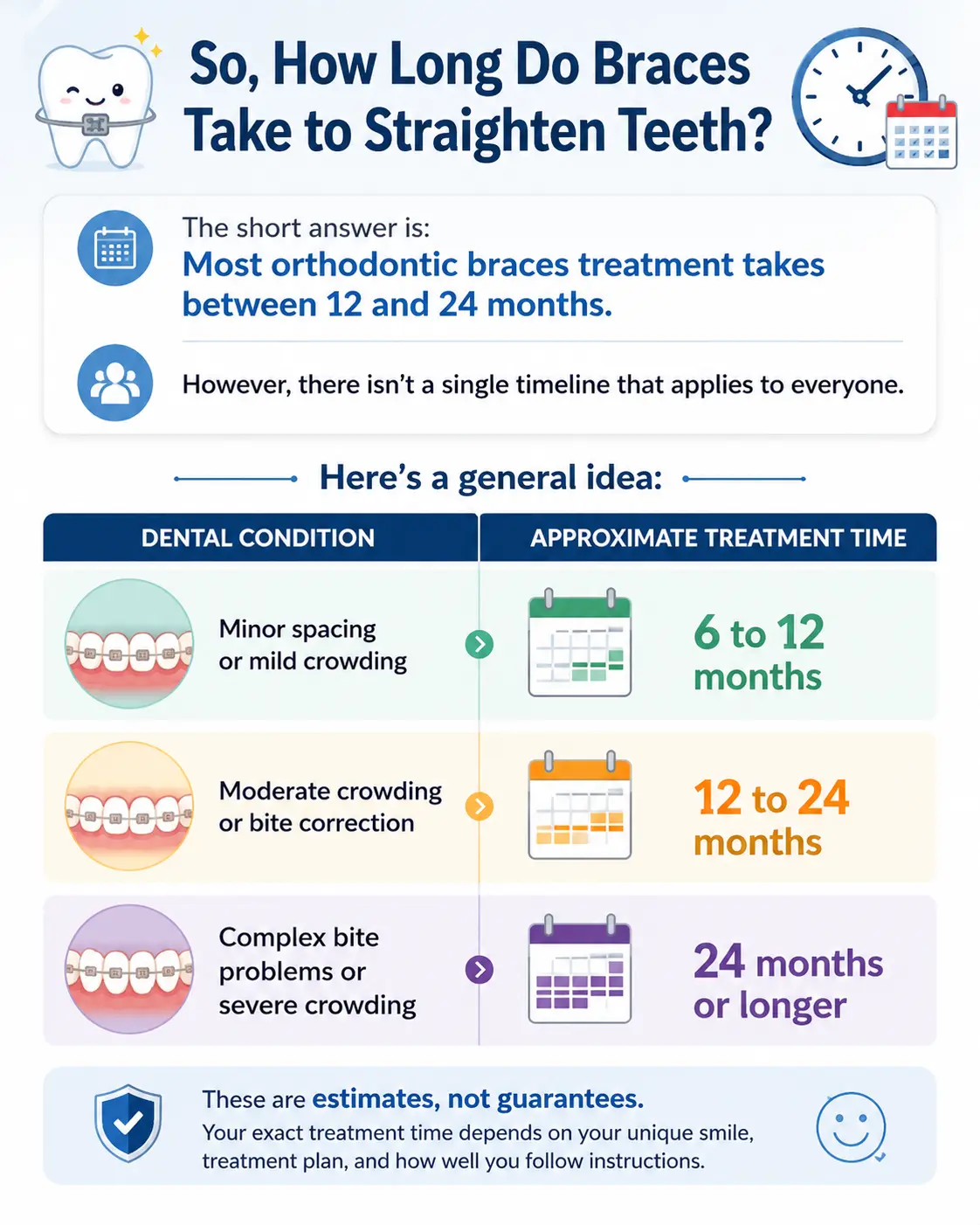
The short answer is:
Most orthodontic braces treatment takes between 12 and 24 months.
However, there isn’t a single timeline that applies to everyone.
Here’s a general idea:
| Dental Condition | Approximate Treatment Time |
|---|---|
| Minor spacing or mild crowding | 6 to 12 months |
| Moderate crowding or bite correction | 12 to 24 months |
| Complex bite problems or severe crowding | 24 months or longer |
These are estimates, not guarantees.
During your consultation, your orthodontists evaluate much more than crooked front teeth. They look at how your upper and lower teeth fit together, jaw alignment, available space, gum health, and whether any teeth need to be removed before treatment begins.
That is why two people with teeth that look “equally crooked” may receive very different treatment timelines.
This is probably the biggest misunderstanding about braces.
Many patients become excited after six or eight months because their front teeth already look straight.
Naturally, they ask,
“Can we remove the braces now?”
In most cases, the answer is not yet.
Looking good in the mirror is only one part of successful orthodontic treatment.
Your orthodontist is also correcting:
Think of it this way.
The first phase is about making your smile look straighter.
The second phase focuses on ensuring those teeth remain healthy, functional, and stable for years to come.
Stopping treatment too early increases the risk of teeth shifting back after braces are removed.
Those extra few months often make the biggest difference in maintaining long-term results.
This is the part most patients are pleasantly surprised by.
Although complete treatment may take one to two years, visible improvements often begin much sooner.
Many patients notice small changes within 6 to 12 weeks, especially if they have crowded front teeth.
Over the next few months, those improvements become more obvious.
Keep in mind that early changes are usually the easiest movements.
The later stages often seem slower because your orthodontist is making very precise adjustments to improve your bite and ensure the teeth settle into their ideal positions.
So don’t judge your progress by comparing month one with month ten.
Orthodontic treatment naturally slows down as it approaches the finish line, and that’s completely normal.
This is where every treatment becomes unique.
When patients ask me, “Doctor, how long do braces take to straighten teeth?”, they’re often expecting a fixed number. But in reality, several factors influence the duration of orthodontic treatment with braces.
Let’s look at the most important ones.
The severity of crowding or spacing is one of the biggest factors.
If your teeth have only mild gaps or slight crowding, treatment is usually shorter.
However, if teeth are severely overlapping, rotated, or impacted, they need to be moved carefully. That naturally takes more time. Because moving teeth isn’t about force. It’s about moving them safely without damaging the surrounding bone and gums.
Many people focus only on the front teeth because that’s what they see in the mirror.
As an orthodontist, I pay equal attention to your bite.
For example, you may have:
Correcting these bite problems often takes longer than simply straightening crooked teeth.
The goal isn’t just a beautiful smile. It’s helping your teeth work together comfortably when you chew, speak, and smile.
Not everyone needs teeth removed before braces.
But if there isn’t enough space to align all your teeth properly, removing one or more teeth may be the healthiest option.
Many patients worry that extractions automatically mean years of treatment.
That’s not necessarily true.
In fact, creating the right amount of space at the beginning often allows teeth to move more predictably and leads to better long-term results.
One of the biggest myths is that braces only work well for teenagers.
That’s simply not true.
Adults can achieve excellent results with braces.
Teenagers may sometimes respond slightly faster because their jaws are still developing. However, I’ve treated many adults whose treatment progressed exactly as planned.
The biggest difference isn’t age.
It’s the condition of your teeth, gums, bone support, and how well you follow your treatment plan.
So if you’re in your 30s or even 40s and wondering if it’s “too late,” the answer is no.
This is the one factor you actually control.
If you’re asked to wear elastics (rubber bands), they need to be worn exactly as instructed.
Skipping them occasionally may not seem like a big deal, but over several months, those missed hours add up.
Similarly:
…can all slow your progress.
Orthodontic treatment works step by step.
If one step gets delayed, every step after it shifts too.
Patients often ask whether choosing ceramic braces or clear aligners will make treatment faster.
The honest answer is:
Usually, no.
The type of appliance has less influence on treatment time than the complexity of your case.
Here’s a simple comparison.
Most orthodontic treatments don’t get delayed because braces stop working.
They get delayed because the treatment sequence gets interrupted.
Some common reasons include:
● Missing Follow-up Visits
Each appointment builds on the previous one.
If you postpone visits by several weeks or months, your treatment timeline naturally extends.
● Broken Brackets or Wires
Hard foods, sticky sweets, chewing ice, or opening packets with your teeth can damage braces.
When brackets come loose, that tooth often stops moving until the bracket is repaired.
Repeated breakages can add several months to treatment.
● Poor Oral Hygiene
Healthy gums respond better to orthodontic treatment.
If plaque builds up around the braces, the gums become swollen and inflamed. Your orthodontist may need to pause certain adjustments until your oral health improves.
Good brushing isn’t just about avoiding cavities.
It also helps keep your treatment moving on schedule.
● Not Wearing Elastics
Rubber bands may look like a small part of treatment, but they’re often responsible for correcting your bite.
If they’re worn only occasionally, bite correction takes much longer.
Many patients are surprised by how much difference this single habit can make.
I understand why many patients ask this.
If you have a wedding coming up, campus placements, or an important event, it’s tempting to look for ways to speed up treatment.
The reality is that teeth can only move at a biologically safe rate. Trying to move them faster can increase the risk of root damage, gum problems, or unstable results.
Instead of asking, “How can I finish in six months?”, ask, “How can I avoid unnecessary delays?”
Here are a few habits that can help keep your orthodontic braces treatment on schedule:
● Attend Every Appointment
Each visit is planned around how your teeth are expected to move. Missing appointments delays the next stage of treatment.
If you know you’ll be travelling, let your orthodontist know in advance so your appointments can be planned accordingly.
● Follow Dietary Advice
Braces aren’t fragile, but they’re not indestructible either.
Avoid biting directly into hard foods like whole apples, sugarcane, hard candies, ice cubes, or nuts. Sticky foods such as chewing gum and caramel can also damage brackets and wires.
A broken bracket might seem minor, but it can stop a tooth from moving until it’s repaired.
● Wear Elastics Exactly as Prescribed
If your orthodontist has advised you to wear elastics, don’t treat them as optional.
These small rubber bands play a major role in correcting your bite. Wearing them only “when you remember” often leads to longer treatment.
● Maintain Excellent Oral Hygiene
Healthy gums help teeth move more efficiently.
Brush carefully around every bracket, floss as instructed, and attend professional cleanings if recommended.
If your gums become inflamed, your orthodontist may need to postpone certain adjustments until your oral health improves.
● Be Patient
This may sound simple, but it’s one of the most important parts of treatment.
Braces don’t work overnight.
Every small adjustment brings your teeth closer to their ideal position. Trust the process instead of comparing your progress with someone else’s photos on social media.
It’s common to wonder whether your braces are actually doing their job, especially during the first few months.
Here are a few changes that are usually normal:
Many patients worry when they notice spaces developing between their teeth.
In most cases, this is actually a sign that the teeth are moving as planned. Those spaces are usually closed during later stages of treatment.
Similarly, slight tooth mobility can feel alarming, but it’s expected because teeth need to loosen slightly before they can shift into a new position.
Some issues shouldn’t wait until your next scheduled appointment.
Get in touch with your orthodontist if you notice:
It’s always better to have a concern checked early than to allow it to affect your treatment progress.
For most patients, treatment lasts between 12 and 24 months. Mild cases may finish sooner, while complex bite problems can take longer. Your orthodontist can give you a more accurate estimate after examining your teeth.
Many patients start noticing visible improvements within 6 to 12 weeks. However, complete treatment takes longer because your bite also needs to be corrected and stabilised.
Not necessarily.
While younger patients may sometimes respond slightly faster, the overall treatment time depends more on the complexity of the case, gum health, and patient cooperation than age alone.
No.
Ceramic braces and metal braces generally produce similar treatment timelines. The choice is usually based on appearance, comfort, and your orthodontist’s recommendation rather than speed.
No.
Straight front teeth don’t always mean treatment is complete. Your orthodontist also needs to correct your bite and ensure your teeth are stable before removing the braces.
Yes.
Orthodontic treatment follows a planned sequence. Missing appointments can delay adjustments and extend the overall treatment duration.
Absolutely.
Elastics are often essential for correcting your bite. Wearing them consistently can help your treatment progress as planned, while skipping them may prolong treatment.
After your braces come off, you’ll usually be given a retainer.
Wearing your retainer as instructed is essential because teeth naturally tend to shift back over time. Retainers help maintain the results you’ve worked hard to achieve.
If you’re searching for “how long do braces take to straighten teeth,” you’re probably trying to understand the commitment before starting treatment.
The answer isn’t just about months. It’s about achieving a healthy bite, a confident smile, and results that last for years.
While most orthodontic braces treatment takes 12 to 24 months, many patients notice encouraging changes much earlier. The exact timeline depends on your dental condition, treatment goals, and how consistently you follow your orthodontist’s instructions.
The best way to know what your journey will look like is through a detailed orthodontic evaluation. After examining your teeth and bite, your orthodontist can provide a realistic treatment plan tailored specifically to you.