I’ll tell you something I see very often in my clinic.
A patient sits down and says,
“Doctor, I don’t understand what’s happening. I keep fixing my teeth, but something or the other keeps going wrong.”
When I check their history, it’s almost always the same pattern.
One tooth was treated. Then another. Then maybe a root canal. Then a crown. Then something broke again.
Nothing was done wrong individually.
But still… things didn’t settle.
If this feels like your story, you’re not alone.
Let me explain what’s usually happening in a simple way.
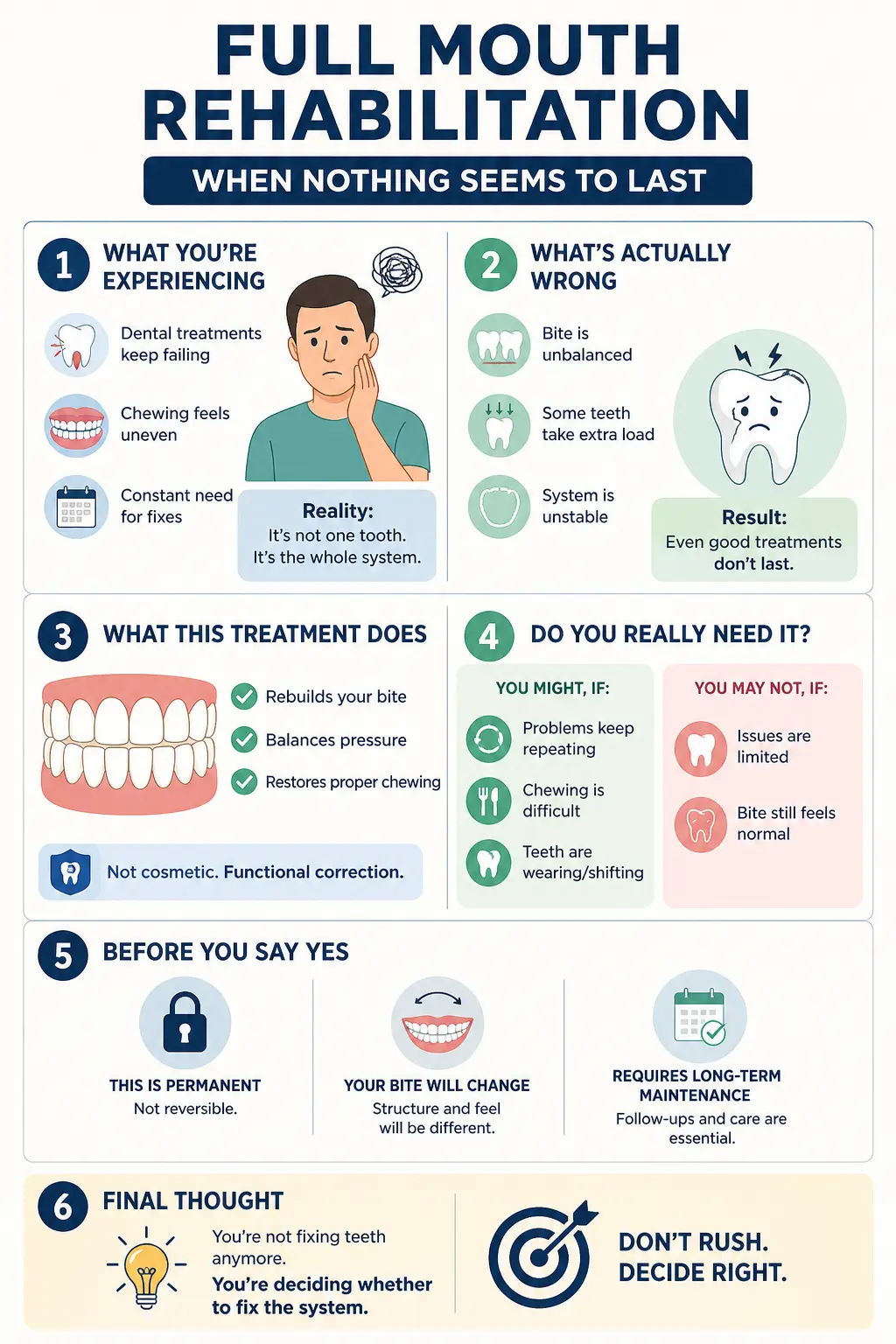
Your mouth is not a collection of separate teeth.
It works like a system.
So when:
The balance slowly starts going off.
At first, you don’t notice it. You can still eat. You manage. But inside, what starts happening is this:
Some teeth take more pressure than they should. Your bite shifts slightly. Your jaw muscles adjust without you realising.
And then one day, a treatment fails… and it feels sudden.
But actually, it has been building up for years.
I remember one patient from Pune, around your age.
He told me, “Doctor, every year I’m doing some dental work. It never ends.”
When we examined him, the issue was not one bad tooth. It was that his bite had completely lost balance.
So every new treatment was being placed on a faulty system.
That’s why nothing was lasting.
This is the stage where we start thinking about full mouth rehabilitation. Now I want to be very clear here. This is not a “bigger treatment” just for the sake of it.
And it’s definitely not something I suggest to everyone.
In fact, many patients who come to me thinking they need it… don’t.
But when it is needed, it’s for one reason:
Things are no longer failing individually.
They are failing together.
What we do in full-mouth rehabilitation is not just about fixing teeth.
We step back and look at the entire system.
Only after that do we plan the treatment.
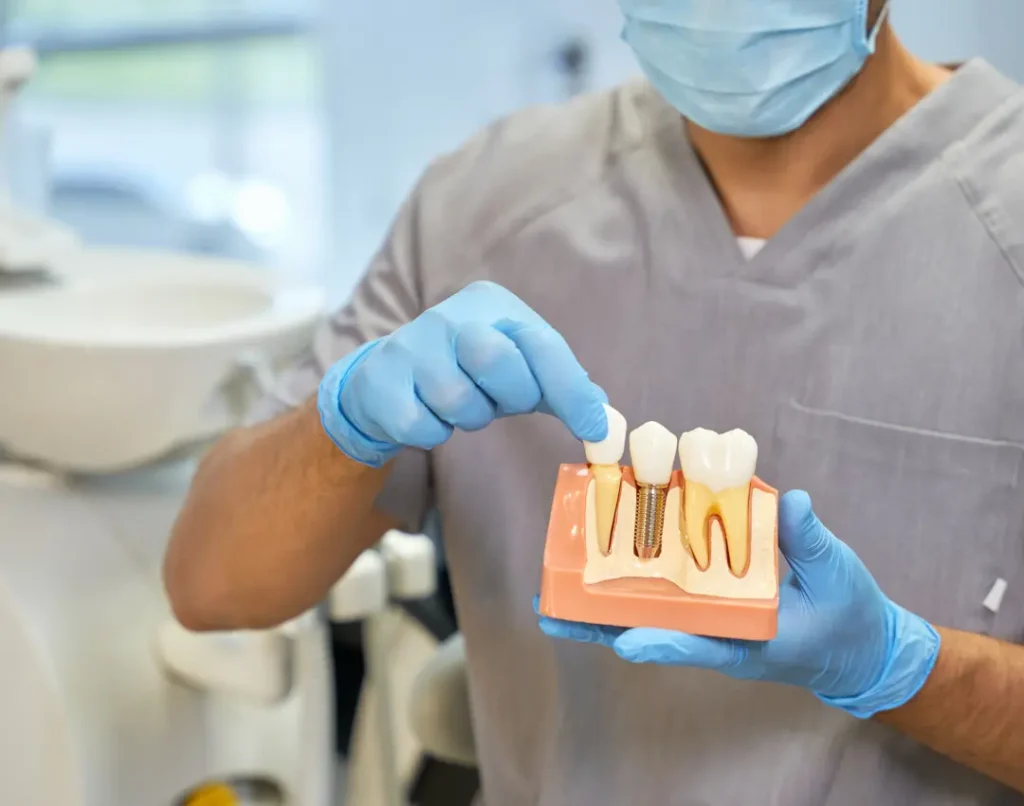
Sometimes it includes implants. Sometimes crowns. Sometimes both.
But those are just tools.
The real work is in planning the balance correctly.
Now I want to slow you down here because this is where patients usually rush.
This is a serious decision.
Once we change your bite and structure, it is not reversible. Your mouth will not return to its earlier condition.
Many patients ask me:
“Doctor, once this is done, will everything be perfect?”
I tell them honestly. It will be stable. It will be functional. But it will not make you “problem-free for life.”
Your mouth is still a living system.
It changes with time, habits, and care.
What this treatment does is:
It stops the cycle of repeated breakdown.
Another thing people worry about is pain. In reality, pain is not the biggest challenge. The bigger adjustment is this:
After treatment, your bite will feel different.
Chewing will feel slightly new.
Some patients even say,
“Doctor, it feels strange… not painful, just different.”
That’s normal.
Your brain has been used to a certain pattern for years. It takes time to adapt to a corrected one.
Let me also say something important, especially for families. Very often, the patient is ready.
But the family asks:
“Is this really needed? Or can we manage like before?”
This is a valid question.
Because yes, you can continue with smaller treatments. But if the system is already unstable, those treatments will keep failing.
So the decision is not between:
treatment vs no treatment
It is between:
temporary management vs long-term correction
At the same time, I also tell patients when NOT to do this.
If your problems are limited,
If your bite is still stable,
If your current treatments are holding well…
Then there is no need to jump into full mouth rehabilitation.
Doing more than required is not good dentistry.
One mistake I see very often in cities like Pune is this:
Patients go to different dental clinics over time.
Each dentist fixes the problem they see at that moment.
But no one looks at the full picture.
So years pass, money is spent, but stability never comes.
If you’re at a stage where you’re considering this, don’t rush.
Ask questions.
Not just:
“What will you do?”
But:
“Why are things failing right now?”
“Why will this plan work long-term?”
“What changes permanently after this?”
A good doctor will not rush these answers.
I’ll leave you with this.
If things were still under control, you wouldn’t be thinking about this. The fact that you’re here means something is not working the way it should. And at some point, continuing the same approach stops helping.
Full mouth rehabilitation is not about doing more treatment. It’s about finally doing the right level of treatment for the condition you’re in.
If you’re unsure, that’s completely fine.
Take your time.
Understand your condition properly, then decide, because this is not a decision you should make quickly.
It’s one you should take correctly.