If you are reading this page, you have likely heard both terms.
Full mouth rehabilitation and smile makeover.
They sound similar.
They are not interchangeable.
And choosing the wrong mental model can create unnecessary fear or false expectations.
As an implantologist, I see this confusion almost every week at Dev’s Oral Care.
Patients walk in worried that being advised implants automatically means their mouth is “beyond saving.”
Others assume a smile makeover is only cosmetic and ignore functional problems.
Let’s slow this down and clear it properly.
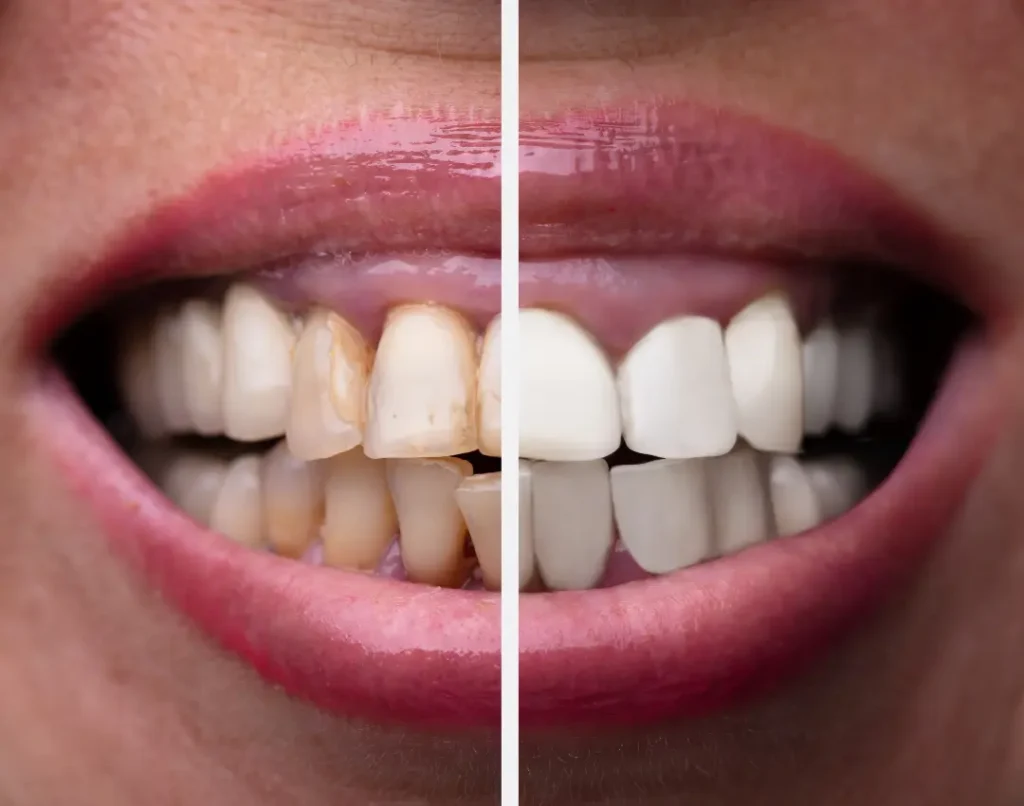
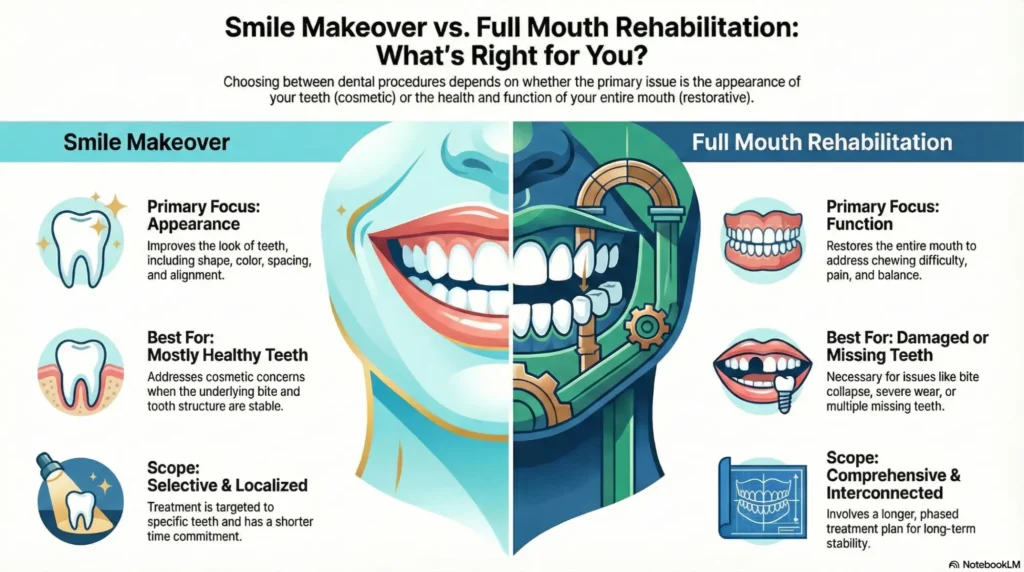
A smile makeover focuses on how your teeth look.
A full-mouth rehabilitation focuses on how your mouth functions.
Appearance vs function.
That is the foundation. Everything else flows from this.
Short answer.
Not always.
Longer, honest answer.
It depends on what is failing.
You can have:
A smile makeover is usually suggested when:
A full mouth rehabilitation is advised when:
So no.
Being advised that full mouth rehabilitation does not mean you neglected your teeth or reached a “point of no return.”
It means the system needs rebuilding, not just polishing.
Think of your mouth as a mechanical system.
Teeth are not standalone units.
They interact with muscles, joints, bones, and bite forces.
A smile makeoverbuildss on a stable system.
A full mouth rehabilitation fixes the system first, then refines the appearance.
If the function is ignored, cosmetic work will fail.
If the function is stable, cosmetic work can last decades.
This is why ethical implantologists refuse to jump straight to veneers or crowns without checking bite balance.
Most commonly:
Typical treatments may include:
Time commitment is moderate.
Reversibility varies.
Maintenance is mostly routine dental care.
Patients who have:
Treatment often includes:
This is medical reconstruction, not cosmetic enhancement.
And yes, it requires more planning, time, and precision.
This is a big myth.
No.
Implants can be:
What defines full mouth rehabilitation is scope and dependency, not the presence of implants.
If one implant restores one missing tooth in an otherwise stable bite, that is not full mouth rehabilitation.
If implants are used to rebuild bite height, chewing balance, and jaw support, then it is.
This is where honesty matters.
Neither is “better.”
They serve different problems.
What creates regret is choosing one without understanding the other.
If a clinic recommends:
That is not expertise. That is convenience.
Every mouth has a different history:
This is why Dr. Kamal Kiswani insists on diagnosis before decisions.
The right treatment should feel custom-built, not pre-packaged.
Instead of asking:
“Do I need a smile makeover or full mouth rehabilitation?”
Ask:
Good dentistry answers these before recommending procedures.
Patients often ask this, expecting a single right answer.
There isn’t one.
The right option depends on what is failing first. Appearance or function.
This table simplifies the decision without oversimplifying the reality.
Aspect | Smile Makeover | Full Mouth Rehabilitation |
Primary focus | Appearance of teeth | Function of the entire mouth |
Typical concern | Shape, colour, spacing, alignment | Chewing difficulty, missing teeth, bite collapse |
Teeth condition | Mostly healthy and stable | Multiple damaged, worn, or missing teeth |
Role of implants | Usually not needed | Often essential but not always |
Treatment scope | Localised and selective | Comprehensive and interconnected |
Time commitment | Short to moderate | Longer, phased treatment |
Reversibility | Some procedures irreversible | Planned for long-term stability |
Maintenance | Routine dental care | Ongoing follow-ups and precision care |
Goal | A better-looking smile | A comfortable, functional, lasting mouth |
If your bite is stable and your concern is mainly cosmetic, a smile makeover may be enough.
If chewing, comfort, or balance is compromised, cosmetic correction alone can fail. That is where full mouth rehabilitation becomes necessary.
No. It means the system needs correction, not that everything has failed. Many patients still retain and use natural teeth as part of the plan.
No. Implants can replace a single tooth or support a full reconstruction. The deciding factor is bite stability, not the number of implants.
Sometimes, but it carries risk. If functional problems exist, cosmetic work may wear down, fracture, or fail early. This decision must be customised.
A correct recommendation explains:
If the explanation feels rushed or formula-based, pause and ask more questions.