Every week, at least two or three patients sit across from me and ask the same thing. “Doctor, bridge or implant, which one should I go for?”
And every time, I give them the same answer: it depends.
That usually earns me a slightly frustrated look. They came expecting a clear verdict. What they got was a non-answer. I understand that. So let me explain what I actually mean because “it depends” is not me avoiding the question. It is the most honest thing I can tell you.
Before patients come to see me, most of them have already spent time reading about this online. And almost everything they have read tells them the same story: implants are the gold standard, bridges are older technology, and if you can afford a dental implant, there is no reason to consider anything else.
I wish it were that simple.
That comparison assumes both options are equally available to every patient. They are not. It does not ask whether your neighbouring teeth are already crowned. It does not ask how long ago you lost the tooth. It does not ask about your bone density, your medications, or your blood sugar levels.
These variables do not just influence the decision. In many cases, they settle it before we even get to the question of cost or preference.
I see this regularly. Two patients, both missing a lower molar. One is 38, healthy, a non-smoker, and came to me within three months of extraction. The other is 61, has controlled diabetes, both neighbouring teeth already have large fillings, and it has been over a year since the tooth was removed.
For the first patient, I would likely recommend an implant. For the second, a well-designed bridge may genuinely be the better clinical choice, not because it is cheaper or simpler, but because it is the right answer for that specific mouth, on that specific day.
Same missing tooth. Different patients. Different recommendations. That is not an inconsistency. That is how this should work.
When I review your X-rays and examine you, here is what I am thinking about and what I think you deserve to understand.
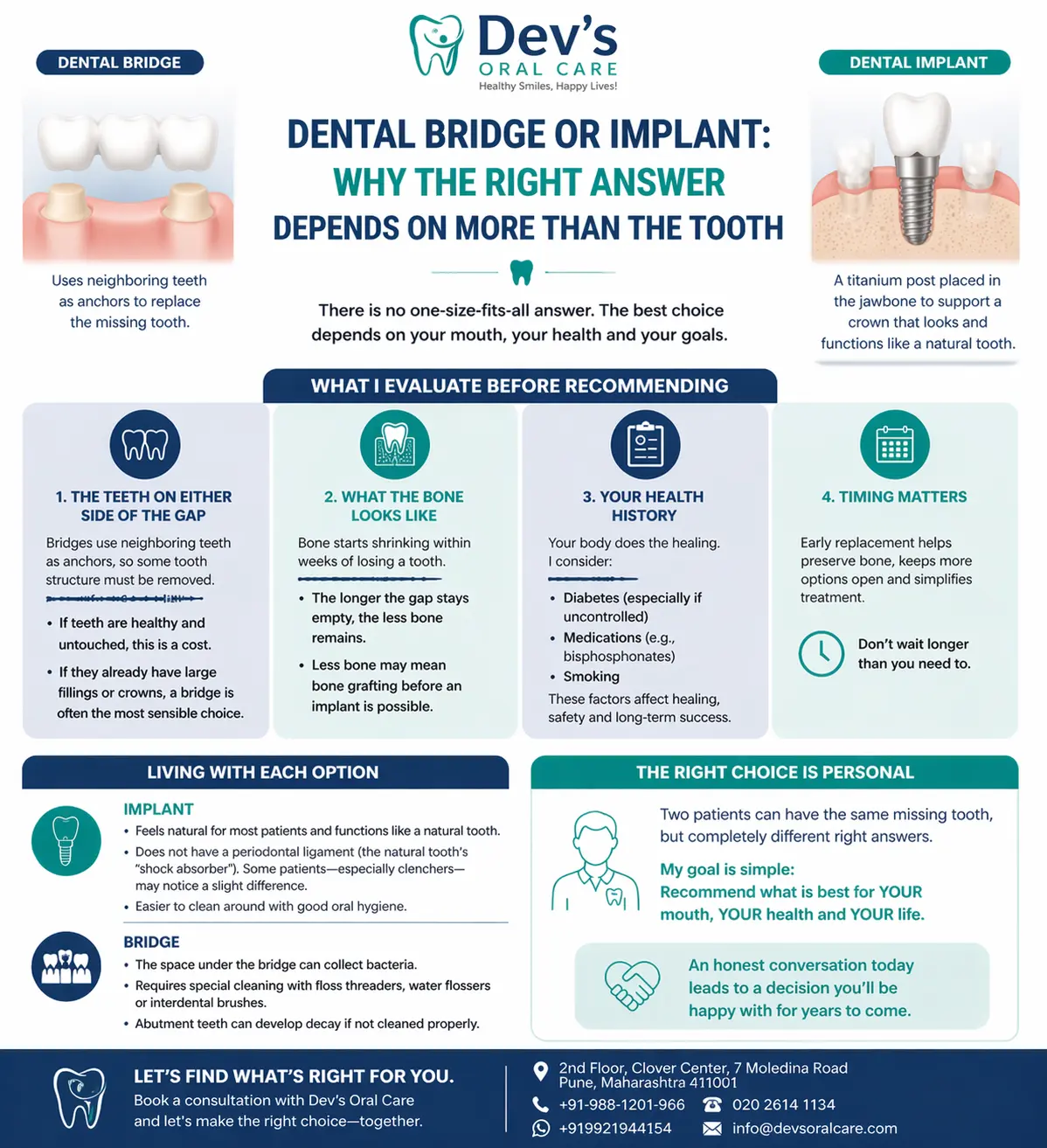
A dental bridge works by using the two neighbouring teeth as anchors. To do that, we prepare those teeth, which means removing some structure from them. If those teeth are completely healthy and untouched, that preparation comes at a real cost. We are shaping teeth that were doing perfectly fine.
But if those neighbouring teeth already carry large fillings or old crowns, the calculation is different. We are not sacrificing intact enamel. We are restoring teeth that were already heavily involved. In those situations, a bridge is not a compromise; it is often the most sensible path.
This is one of the first things I look at.
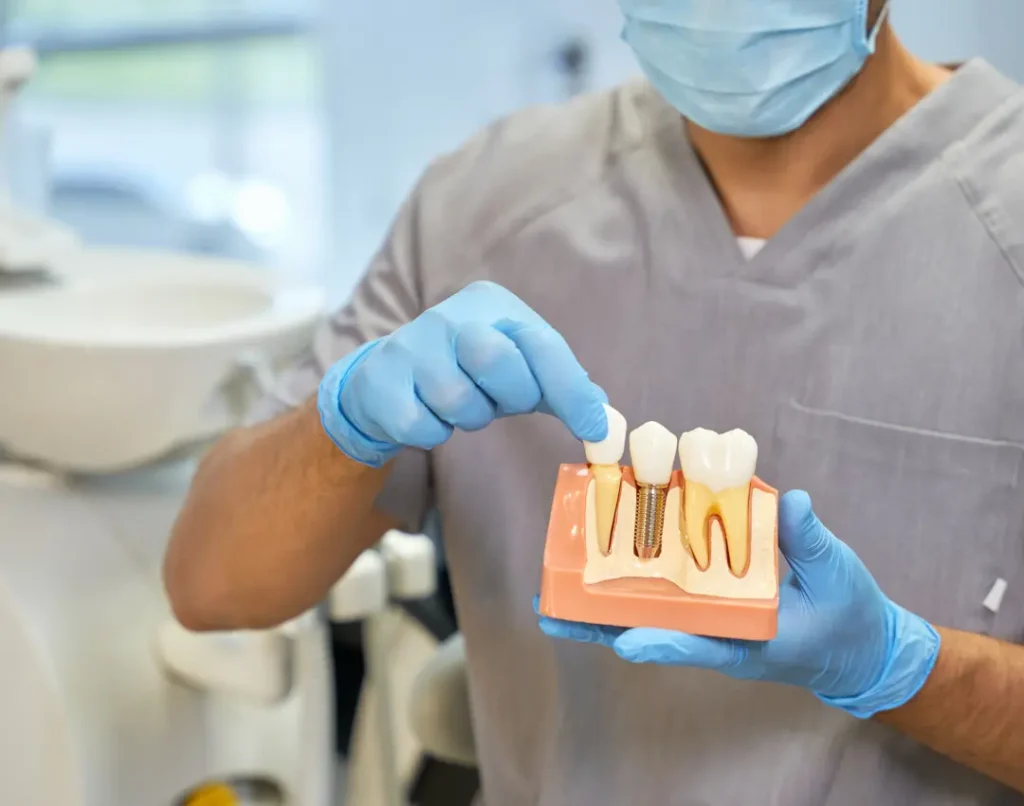
An implant is a titanium post that is placed in your jawbone. For that to work well, the bone needs to be there. Here is what many patients do not know: bone starts shrinking, we call it resorption, within weeks of losing a tooth. The longer the gap sits unfilled, the less bone remains.
I have had patients come to me two years after an extraction who genuinely wanted an implant, only to find that a bone graft was now needed before we could even begin. That means an extra procedure, extra healing time, and a longer treatment journey, none of which would have been necessary had they come in earlier.
I am not saying this to alarm you. I am saying it so you understand why timing genuinely matters.
This is something I tell every patient who sits in front of me: I place the implant, but your body integrates it. And your body’s ability to do that depends on your overall health.
Poorly controlled diabetes slows healing significantly. Certain medications, particularly bisphosphonates, which are prescribed for osteoporosis, affect bone metabolism in ways that change what is safe and advisable. Active smokers face higher implant failure rates. None of this automatically rules anyone out. But it shapes the conversation, the timeline, and sometimes the recommendation entirely.
When I ask about your medical history, I am not filling in a form. I am trying to understand what your body will do with whatever we place inside it.
Most patients with implants eventually stop thinking about the fact that it is an implant. It functions. It holds. That is the usual story, and it is a good one.
But I want to be honest with you about something most articles skip. An implant does not have a periodontal ligament, the thin connective tissue that gives a natural tooth its barely perceptible give under pressure. For most patients, this difference is imperceptible. For a smaller number, particularly those who clench or grind, there is a feedback difference they notice. It is not painful. It is just not identical to a natural tooth.
I tell patients this not to discourage them, but because I would rather you know before treatment than be surprised after.
A bridge has a false tooth suspended over the gum. That space underneath it collects bacteria if you do not clean it deliberately with floss threaders, water flossers, or interdental brushes. I see patients every year whose bridge abutment teeth have quietly developed decay underneath, often with no pain, simply because nobody explained to them that standard brushing is not enough.
Implants are somewhat easier to clean around, but they are not maintenance-free either. Peri-implantitis infection of the tissue around the implant is a real concern, and it progresses silently when hygiene is inconsistent. I follow up with my implant patients for exactly this reason.
Neither option maintains itself. The form of care is different. The need for it is the same.
Bridges most commonly fail through cement washout. The crown loosens, bacteria enter, and the anchor teeth decay underneath, sometimes without pain, which is why it can go unnoticed until the damage is already done.
Implants can fail during the initial healing phase. They can also develop problems years later. I have seen both. A well-placed implant in a well-selected patient, properly maintained, can last for decades. So can a well-made bridge. Longevity is less about the material and far more about whether the right option was chosen for the right patient to begin with.
I want to spend a moment here, because I think it matters.
When both neighbouring teeth are already heavily restored and would benefit clinically from being crowned, a bridge makes genuine sense. When bone loss has progressed past a point where grafting would create a disproportionate burden, a bridge is often the more rational choice. When systemic health factors make surgery a real, not theoretical risk, I am not going to push for an implant simply because it is what I do. And when a patient’s age, overall health, and realistic capacity for long-term maintenance make the demands of an implant genuinely harder to meet, I say so.
Choosing a bridge in any of these situations is not settling. It is good judgment. And it is what I would tell my own family member sitting in that chair.
When neighbouring teeth are completely healthy, and I have no clinical reason to involve them, an implant is clearly preferable. I see no sense in preparing intact teeth for a bridge anchor. When a patient is young, and the replacement needs to serve them for several decades, the implant’s independence from adjacent teeth becomes very significant. When multiple adjacent teeth are missing, implants often provide a more stable foundation than a long-span bridge.
These are not selling points. These are the clinical situations where implants genuinely earn their reputation.
If you are coming in for a consultation, whether with me or anyone else, here are the questions I think you should feel comfortable asking:
A clinician who welcomes these questions is one worth trusting with your treatment.
A standard dental X-ray shows me what is there in two dimensions. A CBCT scan, a cone beam CT, shows me bone volume, bone density, the exact position of the nerve canal, and proximity to the sinus, all in three dimensions. Without it, any implant recommendation I make is incomplete.
If someone recommends an implant based solely on a standard X-ray, it is entirely reasonable to ask whether a CBCT has been reviewed.
If you recently had an extraction and are still thinking through your options, please do not wait too long to be evaluated. The bone under that gap is already changing. It does not mean you have missed your window. But every month of delay changes what we find when we look. That is not pressure; it is just bone biology.
Everything I have written here is honest, and I stand behind it. But none of it tells me what is right for your mouth. That requires looking at your imaging, your adjacent teeth, your health history, and your bone.
What I hope this does is help you arrive at your appointment with me or with any qualified clinician with better questions and a clearer sense of what this decision actually involves.
The right answer exists. We just need to sit together and find it.