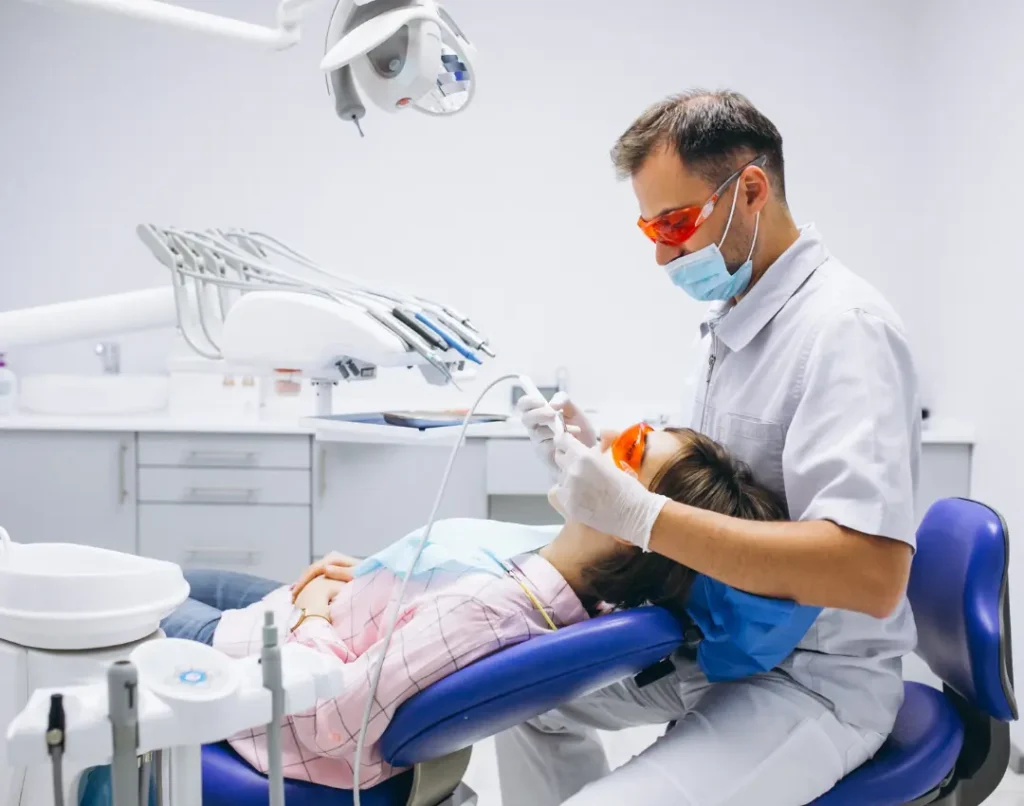
A patient sits in the dental chair, sees the ultrasonic scaler, hears the vibration and thinks:
“If that instrument is strong enough to remove something so hard as tartar, isn’t it also removing some of my tooth?”
If you’ve been considering a professional dental cleaning but keep wondering, “Does teeth cleaning damage enamel?”, it’s worth understanding what actually happens during scaling before you decide to avoid it.
The short answer is NO. Professional teeth cleaning does not normally damage healthy enamel when it is performed correctly.
The purpose of scaling is to remove plaque and calculus that have accumulated on the tooth surface and around the gums. Calculus is hardened plaque and cannot simply be brushed away at home. Once it has formed, professional instruments are needed to remove it.
But there is an important distinction here: “teeth cleaning is safe” does not mean every cleaning is identical, or that every patient will feel exactly the same afterwards.
That is where a lot of online advice becomes oversimplified.
A routine professional cleaning generally involves examining the teeth and gums, removing plaque and calculus with appropriate instruments, and polishing the teeth to remove surface deposits and stains.
Ultrasonic scalers use controlled vibration and water to disrupt and remove calculus. Hand instruments may also be used where more precision is required. Polishing is a separate step and primarily deals with surface staining and deposits.
The important point is that the target is the deposit, not healthy tooth structure.
That is also why the experience can vary from one person to another.
Someone who has very little tartar and healthy gums may have a quick, comfortable cleaning. Someone who has years of calculus buildup, inflamed gums or deposits below the gumline may need more extensive cleaning and may experience some tenderness afterwards.
In other words, the treatment is based on what we actually see in your mouth rather than a fixed “one cleaning fits everyone” approach.
This is probably the second biggest reason people think scaling has damaged their teeth.
You have your teeth cleaned and suddenly cold water feels uncomfortable. Naturally, you wonder:
“Was my enamel scraped away?”
Usually, no.

Sensitivity can occur because tartar may have been covering parts of the tooth surface or exposed root areas. Once those deposits are removed, areas that were previously shielded become exposed to the mouth again.
If gum disease has caused gum recession, the exposed root surface can also be more sensitive because the root is not covered by enamel in the same way as the crown of the tooth.
Patients with heavy tartar buildup or inflamed gums may therefore notice more sensitivity after cleaning than someone who has very little buildup.
This is an important clinical distinction: sensitivity after scaling is not the same thing as enamel loss.
If sensitivity is severe, persistent or getting worse rather than settling, however, don’t simply assume it is “normal cleaning sensitivity.” It deserves a dental examination because cavities, cracks, worn enamel, gum recession and other conditions can also cause sensitivity.
This is another very common concern.
Sometimes, after a large amount of tartar is removed, patients look in the mirror and feel that their teeth have suddenly become longer or that there are spaces between them.
The cleaning itself has not necessarily created those spaces.
Long-standing tartar can accumulate around and between teeth, while gum disease can cause inflammation, gum recession and loss of supporting tissues. Once the deposits are removed, the underlying anatomy becomes much easier to see.
So what feels like a new gap may actually be a space that was previously filled or masked by tartar and swollen gum tissue.
The same applies to teeth that suddenly feel slightly mobile. Scaling does not remove the bone or periodontal ligament that supports a tooth. If a tooth is genuinely loose, we need to investigate the reason for that mobility rather than blaming the cleaning.
This is one reason we don’t look at scaling as an isolated cosmetic procedure. A proper dental checkup in Pune should include an assessment of the gums and supporting tissues, especially when there is bleeding, mobility or significant tartar.

If you brush and floss regularly, you may wonder why you would need professional teeth cleaning at all. The simple reason is that some deposits are stubborn and tend to collect in places your toothbrush cannot reach properly.
Over time, plaque can harden into tartar, particularly around the gumline and between teeth. Once tartar has formed, brushing at home will not remove it. This is where professional scaling can make a difference.
Depending on your oral healt, here are the benefits of teeth cleaning and scaling:
So, teeth cleaning is not just a cosmetic treatment. It is one part of keeping plaque and tartar under control and making it easier to maintain good oral hygiene between dental visits.
There isn’t one number that applies to everyone.
Some patients accumulate tartar quickly. Others maintain excellent plaque control and require professional cleaning less frequently. Patients with gum disease, certain orthodontic appliances, tobacco use or other risk factors may need closer monitoring and more frequent periodontal care.
Rather than booking a cleaning simply because six months have passed, we prefer to look at your teeth and gums and determine what you actually need.
That assessment is particularly important if you have:
If you are searching for a dentist in Pune because your gums have been bleeding for months, for example, a cleaning appointment should not be treated as just a polishing session. The underlying cause needs to be assessed.
No, and this distinction is often missed online.
Routine scaling and polishing is generally aimed at removing deposits from the tooth surfaces and around the gumline.
Scaling and root planing, on the other hand, is a deeper periodontal treatment used when there is gum disease and deposits or bacteria below the gumline. It involves cleaning the root surfaces and is a more involved procedure than a routine cleaning.
So if your dentist recommends a “deep cleaning,” don’t assume they are simply trying to sell you a more expensive version of regular scaling.
Ask why it has been recommended.
A good dental examination should explain whether the issue is routine tartar buildup or periodontal disease requiring more comprehensive treatment.
This is where the answer needs a little more nuance than the simple “scaling never causes damage” statements you may find online.
Professional cleaning is designed to preserve natural tooth structure. However, dental instrumentation still needs to be performed appropriately, with the correct instrument, pressure and technique for the surface being treated.
This is particularly important when there are existing conditions such as exposed roots, enamel defects, restorations or significant periodontal disease.
The goal is never to repeatedly or unnecessarily instrument healthy tooth structure.
That is also why we recommend having cleaning performed by an appropriately trained dental professional rather than treating it as a purely cosmetic procedure.
No. But you should also not think of teeth cleaning as something that should be done blindly on a fixed schedule.
Professional teeth cleaning, when appropriately indicated and correctly performed, is intended to remove plaque and tartar without damaging healthy enamel.
If you experience mild sensitivity afterwards, it does not automatically mean your enamel has been damaged. If you notice mobility, new-looking spaces, significant pain or persistent sensitivity, however, those symptoms deserve proper evaluation rather than being dismissed as a normal consequence of scaling.
The bigger concern is often the opposite: leaving tartar in place because you’re afraid that removing it will harm your teeth.
Tartar cannot be brushed away once it has hardened, and the bacteria and inflammation associated with plaque and calculus can contribute to gum disease over time.
So, when you come to us for a dental checkup in Pune, our aim isn’t simply to make your teeth look clean before you leave. We want to understand what’s happening with your teeth, gums and supporting tissues, explain what you actually need, and recommend treatment accordingly.
Because good dentistry isn’t about doing more treatment.
It’s about doing the right treatment, for the right reason, at the right time.