
Written by Dr. Kamal Kiswani
BDS, MSc in Oral Implantology from Germany | 25+ years of Experience | Maharashtra State Dental Council Reg. No. A-6323
You bite into a piece of chikki at tea time. Something shifts. Your tongue finds a sharp edge where a smooth tooth used to be. Or the crown is sitting in your palm, small and hollow.
Your questions come fast. Is this an emergency? Can it be glued back? Will I need a crown replacement, and what will it cost? Your family WhatsApp group already has an opinion.
We are the team at Dev’s Oral Care, a dental clinic. Here is how we think through a broken crown with our patients, in the order they usually ask.
A crown usually needs replacement when it is cracked through, worn thin, no longer fits, or the tooth beneath it is damaged. A small chip or a loose crown on a healthy tooth can often be repaired or re-cemented. Only an examination and an X-ray can tell which one applies to you.
Call a dentist the same day if you can, and keep the crown safe.
Here is what helps while you wait:
Now the part your WhatsApp group may not tell you.
“Feviquick laga do, kaam chal jayega.” We hear versions of this often. Please do not use Feviquick or any household glue. It can damage the tooth, the gum and the crown for good. Do not wiggle a crown that is still in place, and do not keep chewing on a damaged one.
Some pharmacies sell temporary dental cement. Use it only if a dentist says it is fine, the crown is whole, and there is no severe pain or swelling.
One honest limit. A home measure only buys a few days. It does not fix the reason the crown failed.
So how do you know whether your crown has a problem?
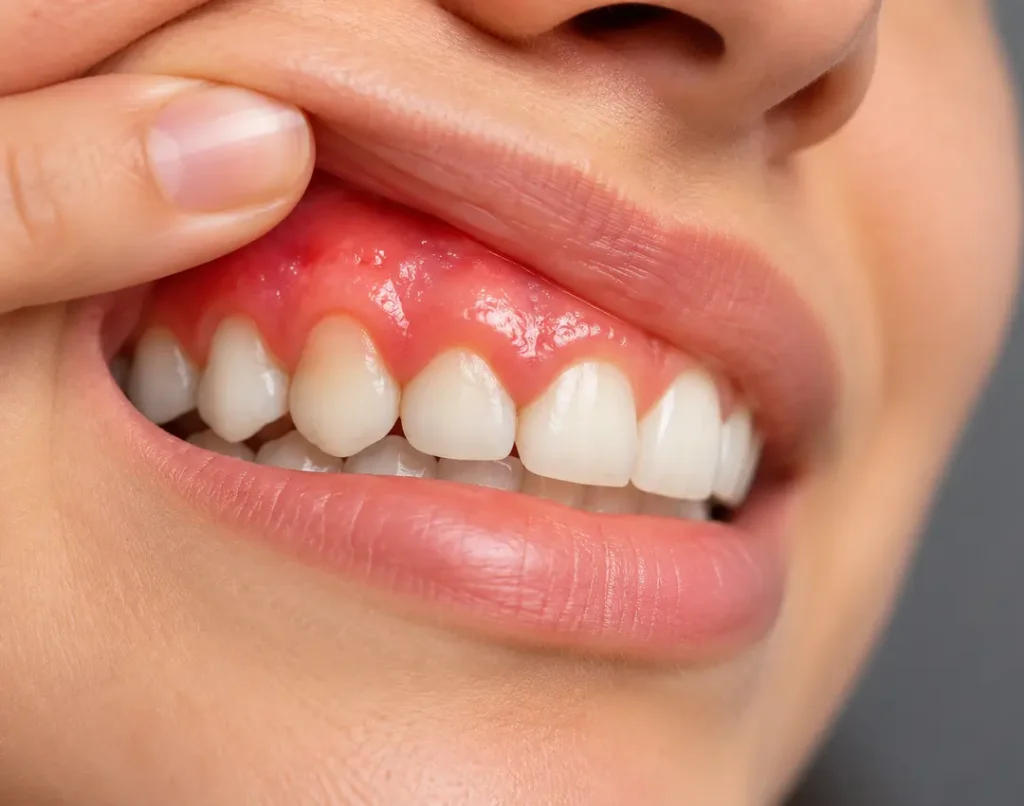
Most people notice it with the tongue first.
Look for these:
Some cracks are too fine to see or feel. They show up only on an X-ray. That is one reason we do not like to decide from a photo.
“Doctor, crown halat aahe, thode divas chalel ka?” (The crown is moving, will it do for a few more days?) We understand the thinking. But a loose crown is a sign that something has changed, either in the cement, the fit or the tooth beneath.
“Doctor, it does not hurt, so it must be fine.” Not always. A crown can leak underneath for a long time without pain. Think of seepage behind a bathroom tile. The tile looks fine, but the damp spreads behind it. When a crown comes off and we see dark staining inside, that often tells us it has been leaking for some time.
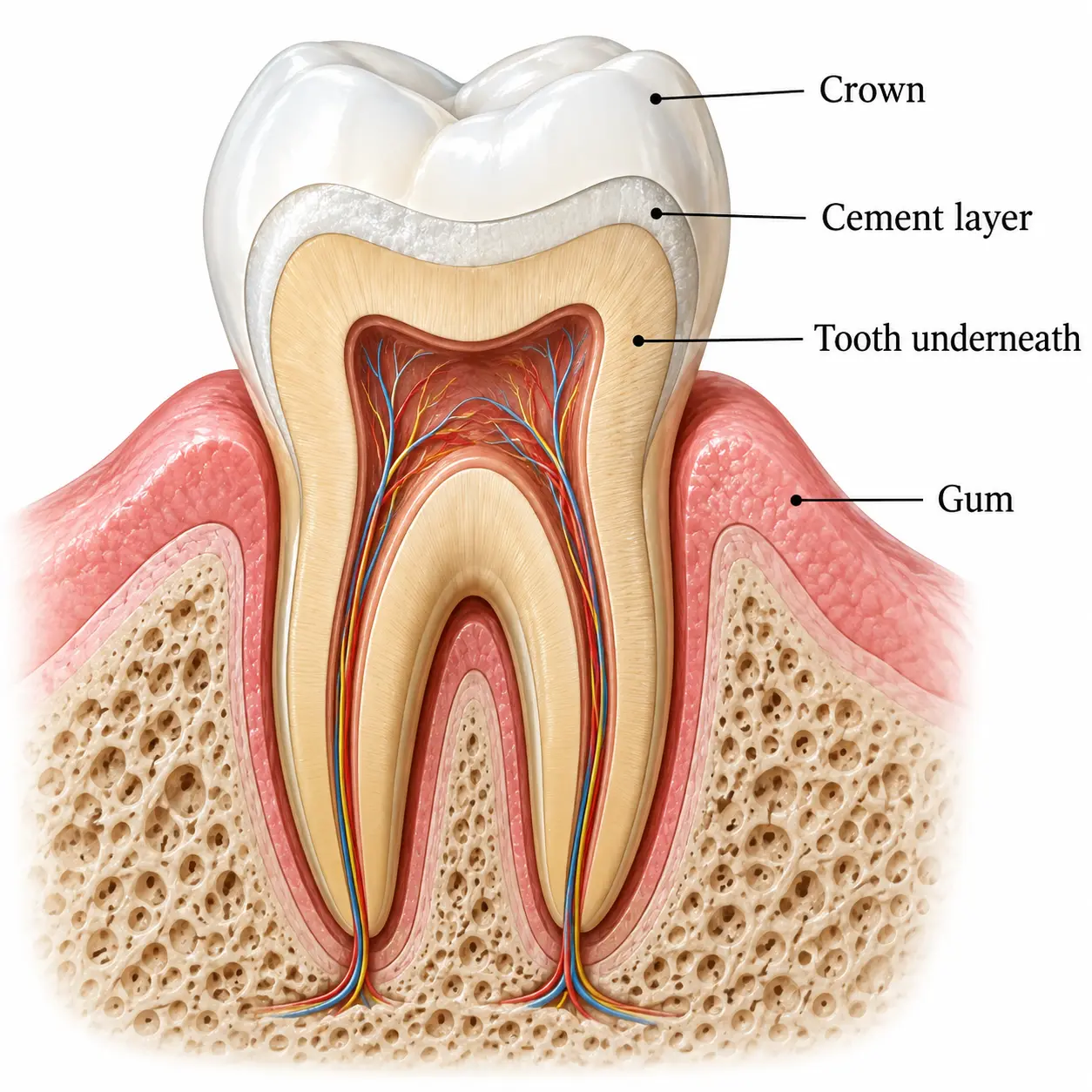
The crown covers the tooth. It does not make the tooth immune to decay.
So why would a crown that was fine for years suddenly give up?
Usually it is one cause, sometimes a few together.
Porcelain-fused-to-metal crowns chip more easily than some other materials. That is a trait of the material, not a mistake you made.
Think of a crown like the lid of a steel tiffin. If the lid is loose, the lid may not be the problem. The box’s rim may be cracked or worn down. The same goes for your tooth.
“Doctor, did I break it by eating something hard?” Sometimes, yes. Often it is years of grinding or a crown reaching the end of its life. We would rather find the cause than assign blame.
Once we know the cause, the real question comes up.
It depends on two things: the condition of the crown and the condition of the tooth underneath it.
So the real question is not “repair or replace?” It is “what is happening to the tooth underneath?”
| What we find | What usually follows |
|---|---|
| A small chip in a porcelain or porcelain-fused-to-metal crown | Smoothing, reshaping, or filling with tooth-coloured resin (bonding), often in one visit |
| The crown has come off, fits well, and the tooth beneath is healthy | Cleaning the tooth and crown, then re-cementing |
| A crack running through the crown, or a crown worn thin | Crown replacement |
| The crown no longer fits, or there is a gap at the edge | A new crown |
| Decay or infection under the crown | Treating the tooth first (a filling or root canal), then re-cementing or replacing the crown |
| The tooth cannot be saved | Extraction, followed by options such as an implant |

A small chip is like a chipped corner on a cup. You can smooth it and carry on. A crack running down the side is different. Whatever is in the cup will find its way through.
Two honest limits here.
First, re-cementing is not a lifetime fix. Even when the tooth is healthy, a re-cemented crown can come off again. We tell you that before we start. Recementation is a process of fixing the crown back if it has debonded. It’s not some treatment procedure separately.
Second, not every rough edge needs a new crown. Sometimes smoothing is all it takes.
If we advise a new crown, ask us to show you why, on the X-ray or in the mirror. A second opinion is a fair request, and we would rather you understand than simply agree.
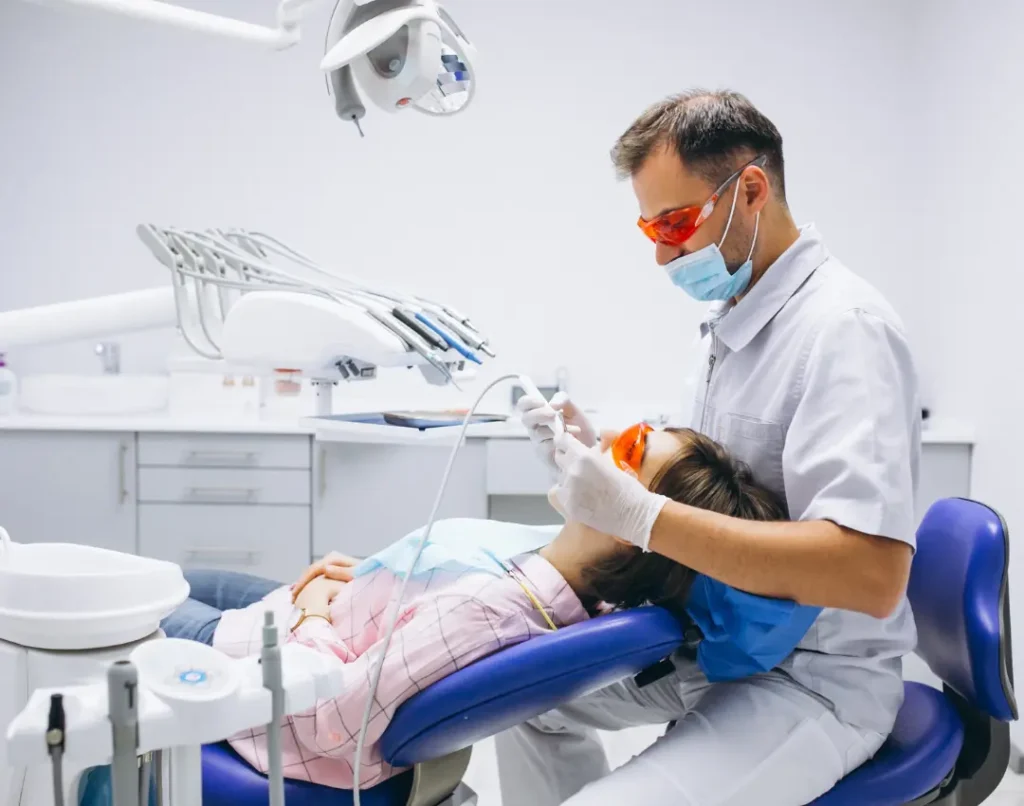
But what does a dentist actually check before deciding?
We start by listening. When did it happen? What were you eating? Does it hurt? Has this tooth given trouble before?
Your answers tell us how urgent it is. Then we look at four things:
If needed, we take an X-ray. We do not take one by habit. It helps when decay under a crown or a fine crack cannot be seen any other way.
We are not simply asking, “Can this crown go back on?” We are asking, “Will it stay, and will the tooth stay healthy under it?”
Please bring the crown if you have it. Many patients bring it wrapped in tissue or in a small box, and that is exactly right.
We cannot tell you from a WhatsApp photo whether a crown can be saved. A photo shows the surface. The problem is usually underneath.
And if the answer is replacement, what does that involve?
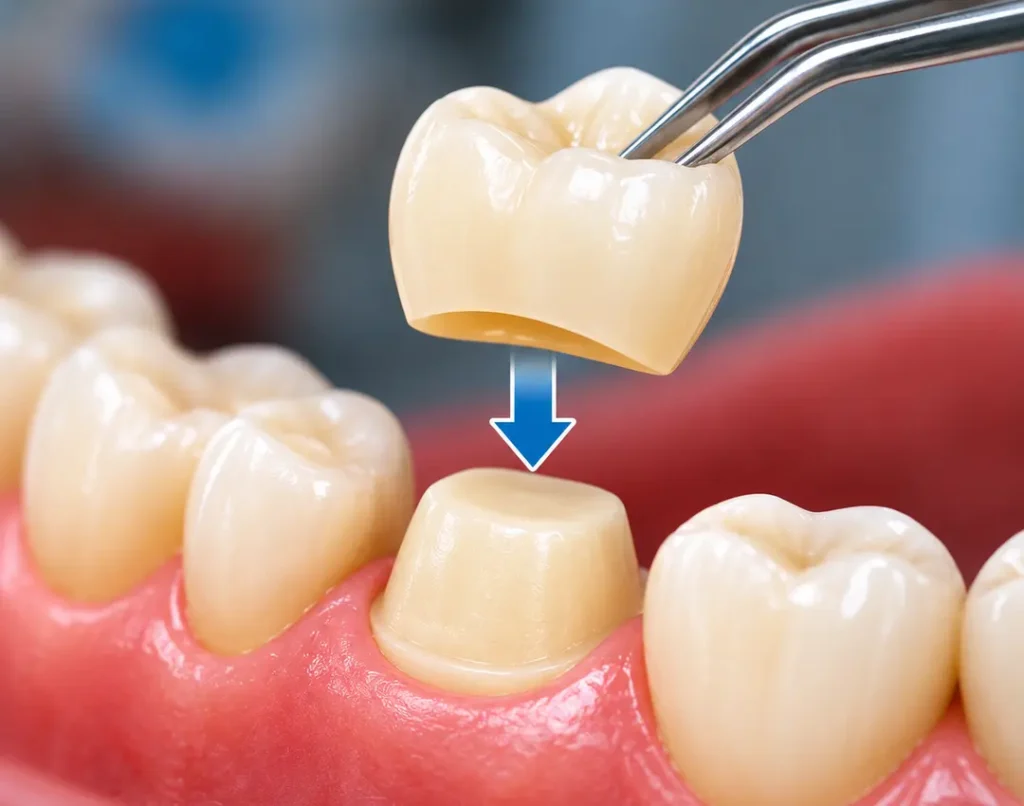
Dental crown replacement usually takes two visits, with a temporary crown in between, though this can vary depending on your tooth and the method used.
The steps, in plain words:
The temporary crown is like a tarpaulin over a leaking roof during monsoon. It protects what is underneath until the proper roof is ready. It is not meant to last.
Crowns come in different materials, such as zirconia, porcelain-fused-to-metal, lithium disilicate and gold. The right choice depends on where the tooth is, how you bite, and whether you grind.
“Doctor, will it hurt?” Comfort is a fair question. We explain what to expect before we begin, and we cannot promise you will feel nothing, because every tooth is different.
Cost is the next question everyone asks. It depends on the material, the tooth, and whether anything needs treating first. We explain the plan and the fee before any work starts.
If the crown belongs to your parent, go with them to the visit. They may not mention a loose crown until it falls out.
Between the first sign and the visit, though, how do you know when it can wait?
Only a dentist can judge this, so describe it when you call. These two lists give you a rough guide.
Usually fine to book the next available visit:
See a dentist the same day:
Swelling that spreads, or trouble swallowing or breathing, needs an emergency hospital, not an appointment.
After the repair, how do you stop it happening again?
Many crowns last somewhere between 5 and 15 years, and some last longer. No crown is permanent, and we cannot promise a set number of years for yours.
What shortens a crown’s life is usually ordinary:
What helps:
Sometimes. If the crown is whole, fits well, and the tooth underneath is healthy, we can clean it and re-cement it. If there is decay or the fit has changed, it usually cannot be put back. Bring the crown with you either way.
It depends. A crown that has come off with no pain can often wait a day or two, but contact a dentist the same day and describe it. Severe pain, swelling or fever needs same-day care.
It usually takes two visits, with a temporary crown in between. The timeline can change depending on your tooth and the method used.
It depends on the material, the tooth's condition, and whether other treatment is needed first. We explain the plan and the fee before any work starts.
No. Household glue can permanently damage the tooth, the gum, and the crown. A pharmacy temporary cement is acceptable only if a dentist agrees, the crown is whole, and there is no severe pain or swelling.
Not necessarily. Often the tooth can be saved. If decay or infection has progressed deep enough, it may need a root canal. If it cannot be saved, we discuss extraction and options such as a dental implant. Being seen sooner usually keeps more choices open.
Often it helps, because some cracks and decay under a crown cannot be seen otherwise. We take one only when it is needed.
Crown replacement is one possible answer, not the only one. A small repair, a re-cemented crown or a new crown can each be right, depending on what is under it.
Bring the crown. Bring your questions.
If you are in Camp, Pune, and would like your crown checked, you can contact Dev’s Oral Care.
Written by Dr. Kamal Kiswani
BDS, MSc in Oral Implantology from Germany | 25+ years of Experience | Maharashtra State Dental Council Reg. No. A-6323