
Written by Dr. Kamal Kiswani
BDS, MSc in Oral Implantology from Germany | 25+ years of Experience
Have you noticed that your teeth look shorter than before? Or that your gums seem to be slowly covering more of your teeth?
Maybe you first noticed it while brushing. The gum between two teeth looked unusually thick. A few weeks later, it seemed to have grown further down. You might not have any pain, but something clearly looks different.
If you’re wondering, “Why are my gums growing over my teeth?” you’re not alone in finding this confusing.
Gums growing over teeth can happen because of gum inflammation, certain medications, hormonal changes, or a condition called gingival enlargement. Sometimes, what looks like extra gum growth is actually swelling caused by plaque and bacteria. In other cases, the gum tissue itself becomes thicker.
The important thing is that not every case is serious, and not everyone needs gum surgery. However, a dentist should examine persistent gum growth to identify the cause and prevent further problems.
Normally, your gums fit closely around your teeth, leaving most of each tooth’s visible surface exposed.
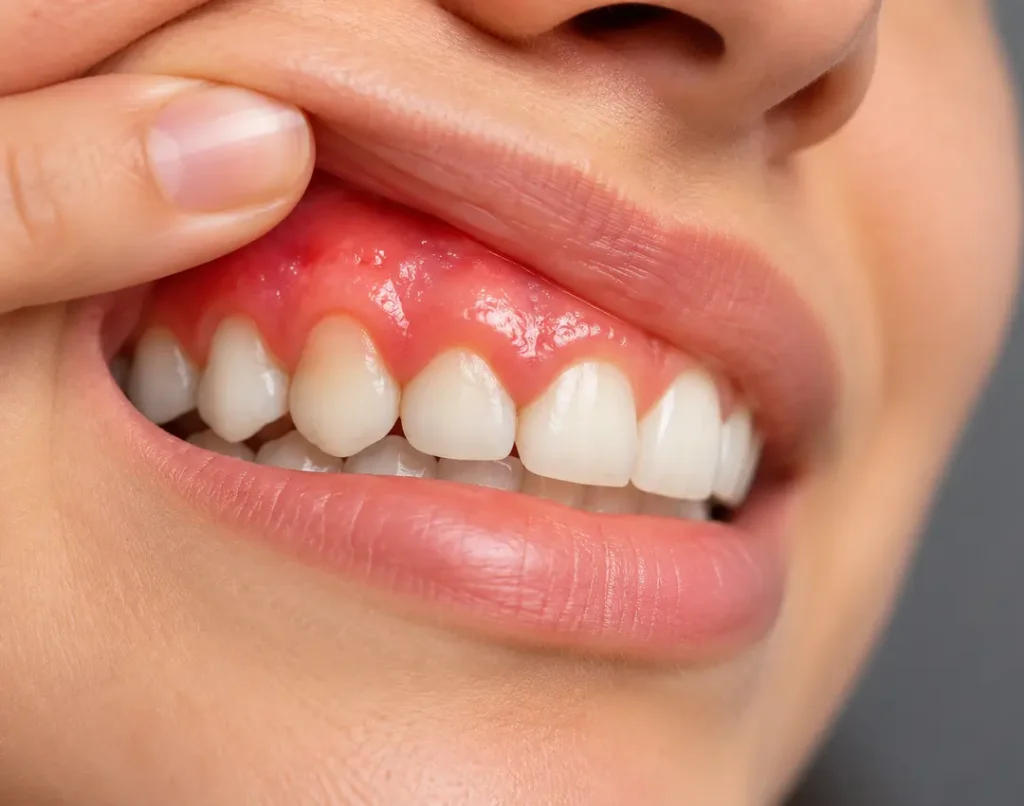
When gum tissue becomes unusually thick or enlarged, it may start covering part of the tooth. Dentists call this gingival enlargement, sometimes called gingival hyperplasia or gingival overgrowth.
It can affect:
In some people, the gums look red, soft and swollen. In others, the excess tissue feels firm and looks almost normal in colour.
This difference matters because the appearance can offer clues about the underlying cause, although it cannot confirm a diagnosis.
According to the American Academy of Oral Medicine, gingival enlargement may result from inflammation, medications, inherited conditions or systemic health problems.
There isn’t one explanation for every case. The location, colour, texture and speed of gum enlargement can help your dentist narrow down the cause.
This is one of the more common reasons gums appear larger than usual.
A sticky layer of bacteria called plaque forms on your teeth every day. When it isn’t removed properly, it irritates the gums and causes inflammation.
You may notice:
This early stage of gum disease is called gingivitis.
As the gums become swollen, they may cover more of the tooth surface than usual. Fortunately, inflammation-related swelling can often improve with better oral hygiene and professional dental cleaning.
However, persistent inflammation can also progress to periodontitis, a more serious form of gum disease that damages the tissues and bone supporting your teeth.
Have your gums started looking thicker since you began taking a new medicine?
Some medications can gradually enlarge gum tissue. This is known as drug-induced gingival enlargement.
Medicines associated with this condition include:
Unlike swollen gums caused by inflammation, medication-related enlargement may feel firm and may not be painful.
Important: Never stop or change a prescribed medicine because of gum growth. Your dentist can discuss the findings with your treating physician to determine whether an alternative is appropriate.
Hormonal changes can make the gums more sensitive to plaque and increase inflammation.
This is particularly noticeable during pregnancy and puberty.
For example, someone who previously had healthy-looking gums may notice increased swelling or bleeding during pregnancy, even without a major change in brushing habits.
Pregnancy-related gum inflammation can sometimes cause a localised growth, often called a pregnancy tumour or pyogenic granuloma. Despite the name, it is generally benign.
However, you should still have any new gum lump during pregnancy examined, rather than assuming it’s harmless.
Sometimes, the problem isn’t that your gums are growing. It’s that a tooth hasn’t fully emerged.
When a wisdom tooth comes through only partially, a flap of gum tissue may remain over part of its surface.
Food particles and bacteria can collect underneath this flap, causing inflammation or infection called pericoronitis.
Common symptoms include pain behind the last molar, swelling, an unpleasant taste and difficulty chewing.
The NHS explains that partially erupted wisdom teeth can cause gum infections, food trapping and other dental problems.
Braces do not automatically cause gums to grow over teeth.
However, brackets and wires can make brushing and flossing difficult. When plaque builds up around these areas, the gums may become inflamed and enlarged.
A similar problem can occur around poorly fitting dental restorations or other areas that trap plaque.
Improving cleaning techniques and removing plaque-retaining factors may help the gums return to a healthier condition.
In rare cases, unusually thick gum tissue runs in families. One example is hereditary gingival fibromatosis, which may begin during childhood.
Certain systemic conditions can also cause gum enlargement.
These are less common than plaque-related inflammation, but you shouldn’t overlook them, especially if gum growth develops rapidly, looks unusual, or cannot be explained by ordinary dental findings.
A dentist may recommend further tests or a specialist evaluation if needed.
This distinction matters because swelling and true gum tissue enlargement may require different treatments.

Often red, soft, tender or prone to bleeding. May improve once the cause of inflammation is treated.

May look thick, firm or pale pink. Can persist when related to medications or inherited conditions.
Illustrative examples only. Appearance alone cannot confirm the cause.
| What you notice | What it could suggest |
|---|---|
| Red gums that bleed easily | Plaque-related inflammation |
| Firm, thick gums without much pain | Medication-related or other gingival enlargement |
| Swelling around one back tooth | Partially erupted wisdom tooth or local irritation |
| Gums slowly covering several teeth | Persistent gingival enlargement |
| A new lump around one tooth | A localised growth requiring examination |
These are possible clues, not a way to diagnose yourself. Different conditions can look similar.
The first sign is often a change in appearance, not pain.
You might notice your teeth look shorter, your gums look bulky, or the spaces between your teeth gradually fill with gum tissue.
Other symptoms can include:
Some people have significant gum enlargement without much pain.
The absence of pain does not necessarily mean your gums are healthy.
Gum overgrowth itself is not always dangerous. However, ignoring it can create problems.
When gum tissue covers more of your teeth, it becomes harder to clean around the gumline. This allows plaque to accumulate, which may increase inflammation and the risk of dental problems.
If untreated, you may develop persistent gingivitis, periodontal disease or difficulty maintaining oral hygiene.
The American Academy of Oral Medicine also notes that severe gum enlargement can interfere with tooth eruption or alignment.
Another concern is that not every gum growth is gingival hyperplasia.
An unexplained lump, unusual gum bleeding, or persistent tissue change should be examined. Occasionally, further investigation or a biopsy is necessary to rule out other conditions.
Arrange prompt dental evaluation if you notice rapidly increasing swelling, worsening pain, pus, fever or difficulty opening your mouth.
Seek emergency medical care if swelling is accompanied by difficulty breathing or swallowing.
Sometimes, but it depends on why the gums are enlarged.
If the problem is mainly inflammation from plaque buildup, the swelling may reduce after professional cleaning and consistent oral hygiene.
Pregnancy-related gum inflammation may improve as hormones stabilise, but any persistent growth still needs assessment.
Medication-related gum enlargement is different. It may improve after a physician-approved medication adjustment, but some people require additional dental treatment.
Firm, longstanding excess gum tissue may not disappear simply because you brush more often.
Trying home remedies for several weeks while the tissue continues growing can delay proper diagnosis.
No single treatment works for everyone.
Before recommending treatment, your dentist needs to determine whether the problem comes from inflammation, medication, a partially erupted tooth, excessive tissue growth or another condition.
If plaque and tartar buildup contribute to gum inflammation, a professional cleaning may be the first step.
Your dentist removes deposits that ordinary brushing cannot eliminate.
As the inflammation settles, the gums may become less swollen and easier to clean.
If an examination reveals gingivitis or periodontitis, treatment focuses on controlling bacterial plaque and inflammation.
Depending on the severity, gum disease treatment may involve professional cleaning, scaling and root planing, personalised oral hygiene advice or additional periodontal care.
Scaling and root planing involves cleaning below the gumline to remove plaque and tartar from the affected root surfaces.
For more advanced cases, the dentist may consider periodontal surgery.
The American Dental Association identifies scaling and root planing as a key non-surgical treatment for periodontitis.
When a medicine appears to be causing gum enlargement, your dentist may coordinate with your prescribing physician.
If medically appropriate, the physician may consider changing the medicine.
However, switching medication is not always possible or necessary. Your dentist may recommend professional teeth cleaning, careful plaque control and regular monitoring instead.
In some cases, gum tissue remains enlarged despite appropriate non-surgical treatment.
A dentist or periodontist may recommend gingivectomy.
This involves removing excess gum tissue to restore a more manageable gum contour.
The procedure is generally performed using local anaesthesia. Depending on the case, the dentist may use conventional surgical instruments or other suitable techniques.
Not everyone with gum enlargement needs a gingivectomy.
Laser-assisted treatment may be an option in selected cases where excess gum tissue needs removal or reshaping.
However, lasers are not automatically superior to conventional methods.
The choice depends on the diagnosis, amount of tissue involved, available equipment and the clinician’s assessment.
For periodontal disease, the American Academy of Periodontology notes that laser treatment has shown outcomes similar to certain conventional non-surgical treatments.
Home care can help control plaque-related inflammation, but it cannot correct every cause of gum enlargement.
Here’s what you can safely do:
Warm salt-water rinses may temporarily ease some types of gum irritation, but they will not remove established gingival overgrowth.
Avoid using strong chemicals or unverified home remedies to shrink your gums.
You do not need to wait until gum overgrowth becomes painful. Ekdum se kuch overnight nahi hota hai, and you can definitely spot signs of gum disease early. You just need to be a little vigilant about your health and notice how you feel.
Book a dental examination if your gums cover more of your teeth than before, the enlargement persists, or brushing becomes difficult.
It is especially important to get checked if the changes began after starting medication, affect only one area, or continue to worsen.
During your appointment, the dentist may examine the gum tissue, check for plaque and gum pockets, review your medical history and recommend X-rays when necessary.
If the enlargement is unusual or unexplained, a specialist assessment or further investigation may be advised.
No, progressive gum enlargement is not generally considered normal. It can happen because of gum inflammation, certain medications, hormonal changes or inherited conditions. A gum flap over a partially erupted wisdom tooth can also look like overgrowth. Some causes are relatively straightforward to manage, but a dentist should examine persistent changes.
If the gums appear enlarged mainly because of plaque-related inflammation, improved brushing, interdental cleaning and professional dental care can help reduce swelling. However, established fibrous gum overgrowth may not respond to home care alone. Natural remedies cannot reliably remove excess tissue or treat every underlying cause.
Front-tooth gum enlargement may be associated with plaque buildup, medication-related gingival enlargement or other conditions. The tissue between the front teeth can become noticeably thick, making the teeth look shorter. Appearance alone can't confirm the cause, so a dental assessment is recommended.
Yes. Gingivitis can cause swelling that makes the gums appear to cover more of the teeth. However, advanced periodontal disease often causes gum recession and loss of supporting bone rather than simple overgrowth. Gum disease treatment depends on whether the problem is reversible inflammation or more advanced periodontal damage.
Yes. Amlodipine belongs to a group of blood pressure medicines called calcium channel blockers, which can sometimes cause gingival enlargement. Not everyone taking amlodipine develops this problem. If you notice gum changes, tell your dentist and prescribing physician. Do not stop the medicine without medical advice.
Not always. Many cases linked to inflammation can improve with professional cleaning and better plaque control. Medication-related cases may require a medication review. Surgery, such as gingivectomy, may be considered when excess tissue persists, interferes with cleaning or affects normal function.
Gingivectomy is usually performed under local anaesthesia, which numbs the treatment area. You may feel pressure during the procedure but should not feel sharp pain. Some soreness, sensitivity or swelling may occur afterwards. Recovery and discomfort depend on how much tissue is treated and the technique used.
Mild plaque-related inflammation may begin improving within days of effective cleaning, although complete improvement can take longer. More severe periodontal inflammation requires professional treatment and follow-up.
Firm medication-related or hereditary gum enlargement may persist until you address the underlying cause, and some cases require surgery.
Yes, recurrence is possible, particularly if the original cause remains. For example, continued exposure to a medication associated with gingival enlargement or inadequate plaque control may contribute to regrowth.
Regular dental examinations and appropriate home care can help manage the risk, although recurrence cannot always be prevented.
A dentist can often identify likely causes through a clinical examination and medical history. They may check gum pocket depths, review medications and recommend dental X-rays. If an area looks unusual, grows rapidly, or doesn't respond to expected treatment, a biopsy or specialist referral may be necessary.
If you have noticed your gums growing over your teeth, the first step is to find out why.
Sometimes, the problem is related to plaque and inflammation and improves with appropriate dental care. In other cases, you may need medication changes, specialised treatment, or removal of excess gum tissue.
The earlier you identify the cause, the easier it is to plan suitable treatment and prevent avoidable complications.
If you’re experiencing persistent gum swelling or enlargement, consult your dentist today.
Written by Dr. Kamal Kiswani
BDS, MSc in Oral Implantology from Germany | 25+ years of Experience | Maharashtra State Dental Council Reg. No. A-6323